Semiconductors & Hardware Engineering
In microprocessor design, delivery delays rarely stem from technical competence; they occur when internal tooling collapses under complexity. Through interaction design and front-end architecture, we unblocked critical workflows without enterprise software overhead or cosmetic distractions.
* This project is presented in anonymized form under corporate non-disclosure agreements. While the broader platform remains confidential, this operational component illustrates how structural interaction design enables throughput.
“We were drowning in emails.”
Senior Tooling Engineer, Global Semiconductor Manufacturer
At a global manufacturer, 100 engineers split across two continents hit a critical operational breakdown: while the master schedule demanded timing closure, 60 engineers remained blocked in physical routing.
As internal tools failed to handle the complexities of business logic, engineering operations collapsed into email threads: leaders were receiving over 200 emails a day trying to track interdependent block tasks.
Operational analysis revealed the core bottleneck: the standard flat forms provided by their Django console were incapable of expressing multi-dimensional hardware dependencies.
The Solution: Prefix Notation and Recursive Trees
To bypass the limits of traditional forms, we integrated a Prefix Tree model into their existing tool, mapping the query interface directly to an Abstract Syntax Tree:
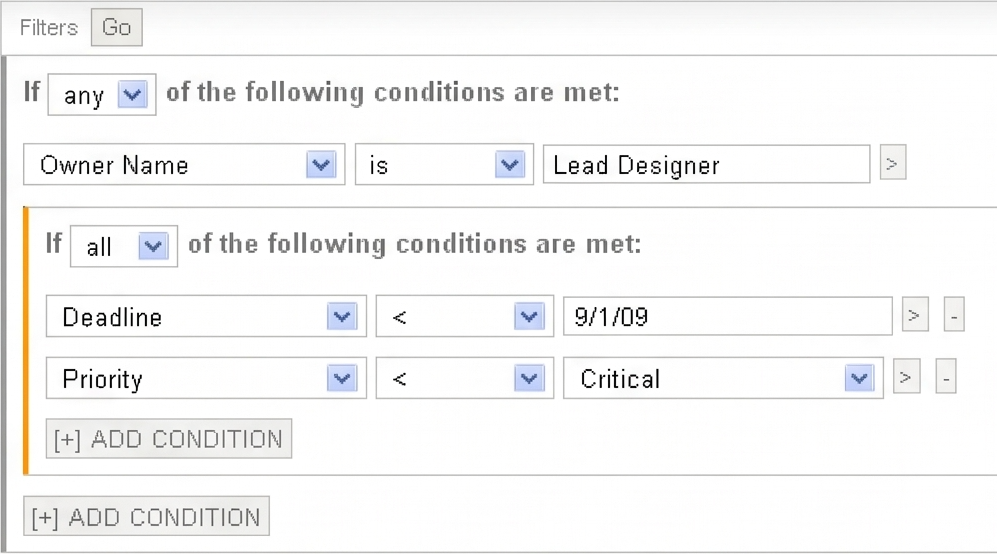
In this architecture:
- The operator encloses the group: Conditions are governed by
Match [ ALL ]orMatch [ ANY ]. - Zero dangling operators: Users can add, delete, or reorder rules without creating invalid syntax states.
- Arbitrary visual nesting: Indentation acts as structural parentheses, allowing leads to evaluate queries like
(A AND B) OR (C AND D)geometrically, without writing boolean logic.
Two-Way Parity: Visual Tree to Raw Code
Forcing an engineer to assemble twenty variations of a complex query through dropdowns is an anti-pattern.
To support technical workflows, the component provided bidirectional code parity: clicking [ Edit XML ] exposed the underlying syntax tree directly.
<assertion id="">
  <group type="any">
    <eval>
      <question id="qOwner" />
      <comparator type="EQ" />
      <answer id="">Lead Designer</answer>
    </eval>
    <group type="all">
      <eval>
        <question id="qStage" />
        <comparator type="EQ" />
        <answer id="pr">Place and Route</answer>
      </eval>
      <eval>
        <question id="qStatus" />
        <comparator type="NEQ" />
        <answer id="blk">Blocked</answer>
      </eval>
    </group>
  </group>
</assertion>
Engineers could edit the raw XML directly, toggle back, and see the validated tree render instantly.
Preserving the Existing Stack: Why Visual Redesign Was an Anti-Pattern
Enterprise software initiatives often misallocate capital on cosmetic overhauls. Changing button styling, margins, or fonts would not have unblocked a single engineer. The existing Django Admin styling was entirely functional; the bottleneck was that standard form components cannot model multi-dimensional logic.
Interaction design is not cosmetic styling; it is the operational logic connecting human intent with system architecture. Based on that diagnosis, we left the visual layer intact and focused exclusively on the structural bottleneck: the interaction architecture of query building.
Knowing Which Pattern to Apply
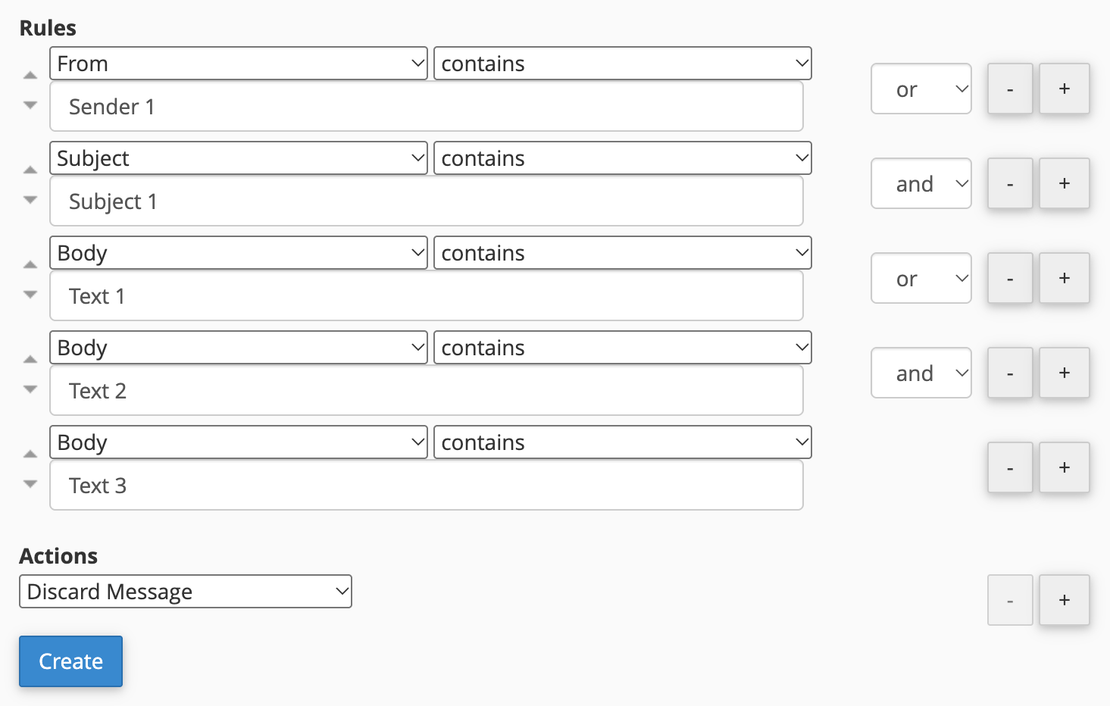
When tasked with building complex filters, developers often map backend code directly onto the UI, inserting inline AND / OR selectors. This creates the ambiguity seen in widespread server tools like cPanel: in a sequence like A OR B AND C, the interface fails to communicate operator precedence.
Apple previously demonstrated the value of natural language Prefix Notation in Apple Mail (“If [any / all] of the following conditions are met”). However, for mass consumer usability, Apple intentionally restricted this pattern to a flat list.
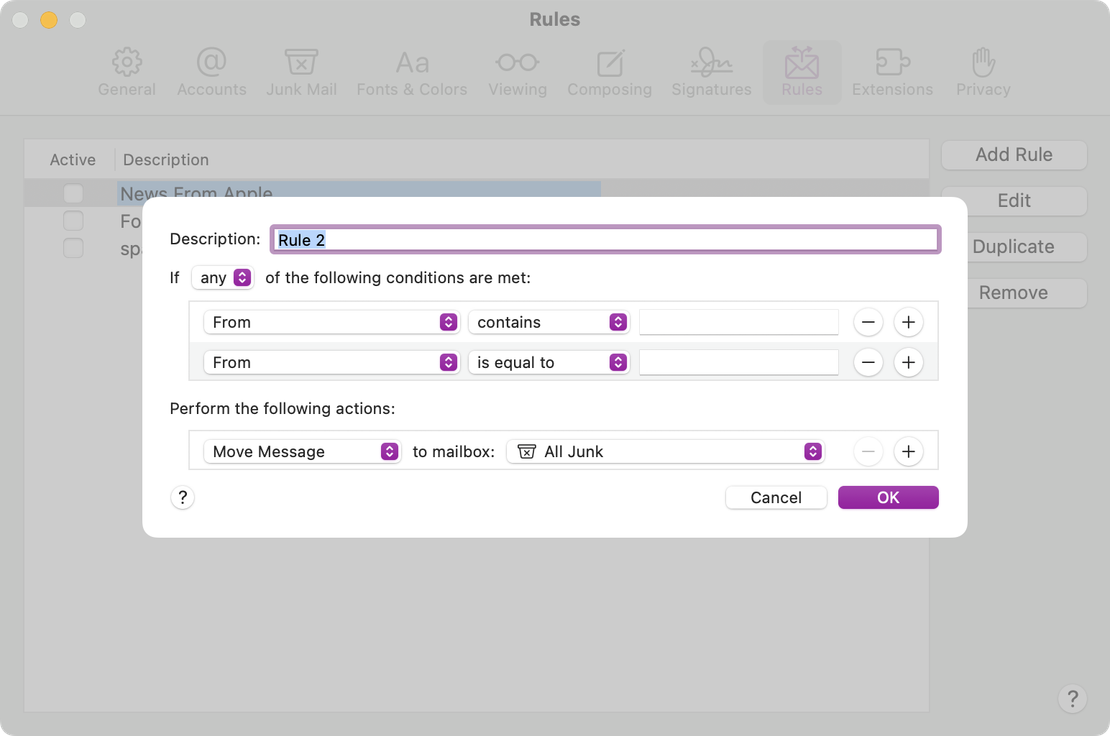
Microprocessor dependencies required nesting. We didn’t reinvent the wheel (which is a terrible idea in interaction design): we evaluated and adapted Apple’s prefix model to support recursive groups, and plugged it into their existing Django tool.
While the broader platform remains under NDA, this component was a leverage point: giving leads a reliable way to query parallel tasks without leaving the console.
Results: Restoring engineering throughput
Unblocking a multi-million-dollar microprocessor timeline did not require replacing enterprise systems or rebuilding backend databases.
By embedding a formal interaction architecture into their existing Django tool, technical leads could isolate delayed tiles and execute bulk actions across parallel engineering tracks in seconds.
And 100 chip engineers had the right tool to coordinate their efforts, and return their focus to what actually matters: shipping silicon on schedule.

Keywords

“The biggest bang for the buck is in the chip design area, where all these tile-level tasks run in parallel and there is a current inability to manage the process well.”
– Internal Project Assessment